

Blog
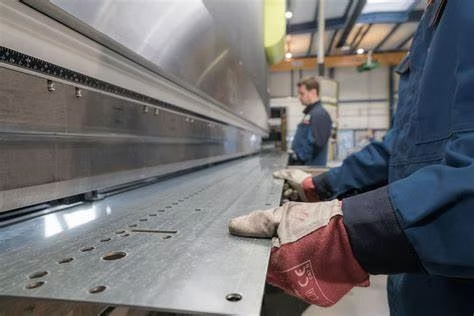
Sheet metal bending
Bending - explanation, procedure, how to do it and recommendations Bending is a technological operation in which a material is permanently deformed in the desired direction and shape. By using force and bending moment appropriately, the desired shape change is achieved without a significant change in the basic cross-section of the bent material. The material is stretched on the outside and compressed on the inside. Bending can be simple or can consist of individual steps and a combination of V- and U-shaped bends. It is usually bent cold, in the case of thick materials it is bent hot. A great advantage of this technology is the deformation strengthening of the material itself, which necessarily occurs.
Nowadays, it's impossible to do without bending.
Bent parts and products are very widespread on the market today. They are found almost everywhere around us, whether separately or in finished units and products. Thanks to the development of bending, there has been a huge development, there has been an increase in efficiency, a reduction in production costs, and a simplification of work procedures. It is used in every industrial sector, especially: mechanical engineering, automotive industry, agriculture, construction, shipbuilding, railways, storage, handling equipment, traffic signs, public lighting, fences, doors, gates…
Basic classification of bending machines:
manual: Advantages - affordable due to low price Disadvantages - low accuracy, only suitable for thin materials
motor: outdated and inefficient
CNC press brakes: precise, efficient
What material can be bent?
The base material must have sufficient ductility for bending. This is necessary to prevent it from breaking.
Scratch protection
When bending materials where the emphasis is on the smoothness of the surface and the final appearance, protective inserts are used, most often silicone or plastic. Some sheets, especially stainless steel and aluminum, have a protective film on them (see the gallery) which, with appropriate adjustment and tuning of the bending process, will last without damage. The original surface on the protected side will retain its original intact appearance.
The order of bends needs to be thought out in advance
– Springback: after the bending force is relieved, the material returns by a certain angle. This angle is called the springback angle and must be taken into account when bending. This means that the bent material must bend more than the springback angle to achieve the desired dimension. This angle depends on the properties of the material itself.
-Minimum bending radius: this is the minimum dimension and if it is exceeded, the fibers of the material on the outer stretched side will break and it will be damaged. This dimension depends on the plasticity of the material, the type of material, its thickness, quality and the method of bending.
The 5 biggest mistakes when bending:
-incorrect bend order: Bends must be planned in advance so that the part can be inserted between the prism and the knife
-inappropriate parameter setting: The pressure force is unnecessarily high and the knife is pressed into the bent material
-material unsuitable for bending: Brittle material breaks or tears at the outer edge
- Failure to respect the orientation of the material fibers: The properties of the material are already influenced during its production. For example, rolled sheet metal has a different springback angle when bending depending on the orientation of its fibers. It is important that the customer is aware of this and that this fact is taken into account when designing the component.
-dirty, deeply scratched, corroded material: We do not bend such material